

Blog income timeline
The question appears somewhere between your third and tenth blog post: “When will this actually make money?”
It’s a fair question. You’re investing time you don’t have, learning skills that feel foreign, and publishing content that currently earns nothing. At some point, you’d like to see a return on that investment—even a small one.
The problem is that most income timelines you’ll find online are either wildly optimistic (“I made $10,000 in my first three months!”) or frustratingly vague (“It depends on so many factors…”). Neither answer helps you set realistic expectations or plan your approach.
This article cuts through both the hype and the hedging. We’ll look at what actually determines when blogs start generating income, what “making money” realistically looks like at different stages, and how to think about monetization without derailing the consistency that makes blogging sustainable for busy people.
You’ll walk away with honest timelines, an understanding of what influences those timelines, and realistic benchmarks for your own blog’s income potential.
Who This Article Is For (And Who It’s Not For)
This guide is for you if:
- You’re blogging as a side project while working full-time or managing other major commitments
- You want honest income expectations, not get-rich-quick fantasies
- You’re willing to invest 12-24 months before seeing meaningful returns
- You want to understand the factors that influence blog income timing
This might not be for you if:
- You need income from your blog within 3-6 months to cover essential expenses
- You’re treating blogging as a full-time business from day one with 30+ hours weekly to invest
- You’re looking for passive income shortcuts or automated money-making schemes
- You’re unwilling to create consistent content for at least a year
The Uncomfortable Truth About Blog Income Timelines
Most blogs don’t generate any meaningful income in their first year. Some don’t earn anything substantial in their second year either.
This isn’t because those blogs are failures or because the bloggers did something wrong. It’s because building the foundation that supports blog income—traffic, trust, authority, audience relationships—takes time regardless of how talented you are or how good your content is.
According to a ProBlogger survey, 38% of bloggers report making no money at all after a year of consistent blogging. Another 25% earn less than $100 monthly after 12 months. Only about 10% of bloggers earn over $1,000 monthly in their first year.
These numbers aren’t meant to discourage you—they’re meant to calibrate your expectations to reality. When you understand that slow initial income is normal, you stop interpreting it as personal failure or evidence that blogging doesn’t work.
Why the Timeline Stretches Longer Than You’d Prefer
Blog income depends almost entirely on traffic volume. More visitors means more ad impressions, more affiliate link clicks, more product sales, more opportunities for sponsored content.
But building significant traffic takes time because:
Search engines need months to trust and rank new content. Google doesn’t immediately rank your posts highly just because they’re good. New domains typically take 6-12 months to build enough authority for competitive keyword rankings, according to Ahrefs research.
You need a substantial content library before traffic compounds. Your first 10 posts might collectively attract 100-500 monthly visitors. Your next 20 posts add to that. Traffic growth accelerates as your library expands because each post creates another entry point for new readers.
Audience trust develops through repeated exposure. People rarely buy something or click an affiliate link the first time they encounter your blog. They need to read several posts, see that you consistently provide value, and develop trust in your recommendations.
Monetization methods have minimum traffic thresholds. Ad networks often require 10,000-25,000 monthly pageviews before accepting you. Affiliate income becomes meaningful around 5,000-10,000 monthly visitors. Sponsored content opportunities appear around 10,000+ monthly visitors for most niches.
When you understand these factors, a 12-24 month timeline before meaningful income makes sense rather than feeling like an eternity.
What “Making Money” Actually Looks Like at Different Stages
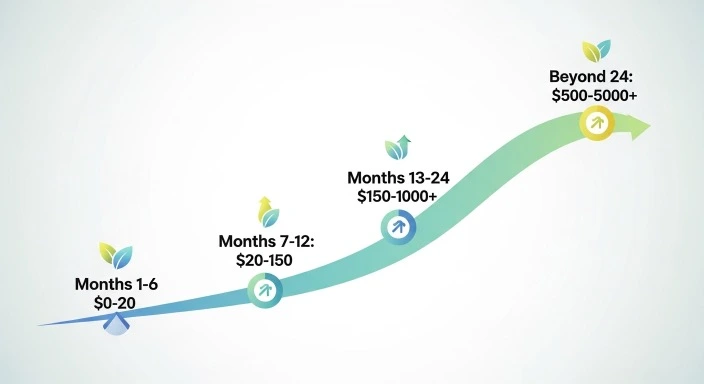
Blog income isn’t binary—you don’t go from $0 to $1,000 overnight. Understanding the typical progression helps you recognize progress even when the numbers feel small.
Months 1-6: The Zero-Income Foundation Period
Typical earnings: $0-$20 per month
Typical traffic: 100-1,000 monthly visitors
Primary focus: Publishing consistently, learning SEO basics, building your content library
This stage feels discouraging because you’re working hard with minimal tangible return. You might make your first $5 from an affiliate link or $10 from a small ad network, but income isn’t reliable or meaningful yet.
What’s actually happening during this period is foundation-building that you can’t see in your bank account. Search engines are indexing your content. Early readers are discovering your site. You’re developing your voice and learning what resonates with your audience.
This is the stage where most bloggers quit, mistakenly believing that zero income after six months means they’re failing. In reality, they’re right on schedule for typical blog development.
Months 7-12: The First Meaningful Income Appears
Typical earnings: $20-$150 per month
Typical traffic: 1,000-5,000 monthly visitors
Primary focus: Optimizing existing content, expanding successful topics, beginning strategic monetization
Some posts start ranking well in search results. Your traffic becomes more consistent rather than sporadic. You might reach minimum thresholds for better ad networks or start seeing regular affiliate commissions.
The income still isn’t life-changing, but it’s psychologically important. Earning $75 in a month proves that blog monetization works for you specifically, not just for other people. This validation often provides the motivation to continue through the slower growth periods.
Many part-time bloggers stay at this level for 12-18 months while they continue building. There’s nothing wrong with this—you’re generating supplemental income while maintaining the consistency that enables future growth.
Months 13-24: Income Becomes More Substantial
Typical earnings: $150-$1,000+ per month
Typical traffic: 5,000-25,000 monthly visitors
Primary focus: Scaling what works, developing multiple income streams, creating higher-value monetization
Your content library now includes 40-80+ posts. Several rank on page one for their target keywords. You have data showing which topics perform best and which monetization methods work for your audience.
Income at this stage varies dramatically based on niche, monetization strategy, and traffic quality. A blog with 10,000 monthly visitors in a high-value niche (finance, software, business) might earn $800-1,500 monthly. The same traffic in a lower-value niche (general lifestyle, entertainment) might generate $200-400 monthly.
This is when blogging starts feeling like a legitimate side income source rather than a hobby that occasionally pays for coffee.
Beyond 24 Months: Continued Growth or Plateau
Typical earnings: Highly variable ($500-$5,000+ monthly for part-time bloggers)
Typical traffic: 10,000-100,000+ monthly visitors
Primary focus: Determined by individual goals—some bloggers scale aggressively, others maintain steady supplemental income
After two years of consistent work, your blog has enough momentum that growth can continue with less effort, or you can deliberately scale for faster growth if you choose to invest more time.
Some bloggers at this stage maintain 5-10 hours weekly and generate steady $500-1,000 monthly income indefinitely. Others increase their time investment to 15-20 hours weekly and grow toward $2,000-5,000+ monthly. Both paths are valid—it depends on your goals and available time.
Factors That Accelerate or Delay Your First Blog Income
While typical timelines provide useful benchmarks, several factors significantly influence when your specific blog starts generating income.
Your Publishing Consistency and Frequency
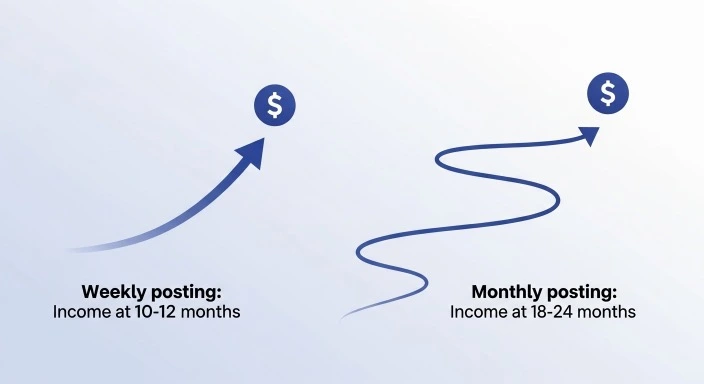
A blog publishing weekly reaches income milestones faster than one publishing monthly, simply because it builds a content library and traffic base more quickly.
If you can sustainably publish one quality post per week, you might reach meaningful income ($200-300 monthly) around month 10-12. If you publish one quality post per month, that same milestone might arrive around month 18-24.
Neither schedule is “better”—what matters is choosing a frequency you can actually maintain. A blog that publishes monthly for three years outperforms a blog that publishes weekly for six months then abandons the effort.
Your Niche’s Commercial Value
Some topics simply generate more income per visitor than others because companies pay more to reach those audiences.
High-value niches include: personal finance, business software, web hosting, insurance, legal services, B2B services, health and wellness products, home improvement, and investing.
Lower-value niches include: general lifestyle, entertainment, humor, personal journals, and creative writing.
If you’re blogging about credit cards or business software, you might earn $50-100 per 1,000 visitors through affiliate commissions. If you’re blogging about poetry or travel stories, you might earn $5-15 per 1,000 visitors through ads.
This doesn’t mean you should abandon a lower-value niche you’re passionate about—it just means your income expectations should account for this reality. You’ll need more traffic to generate equivalent income.
Your SEO Understanding and Implementation
Blogs that implement basic SEO from the start grow traffic faster than those that ignore it then try to retrofit optimization later.
Basic SEO includes: targeting specific keywords, creating clear URL structures, writing descriptive titles and meta descriptions, using header tags properly, building internal links between related posts, and ensuring fast page load speeds.
You don’t need to be an SEO expert, but understanding and implementing fundamentals significantly accelerates the timeline from content creation to traffic growth to income generation.
Your Monetization Strategy Alignment
Some monetization methods require minimal traffic but pay less per visitor. Others require substantial traffic but pay much better.
Quick-to-implement, lower-paying options: Display ads through networks like Google AdSense or Mediavine (once you meet their traffic minimums), Amazon Associates affiliate program, basic affiliate programs in your niche.
Slower-to-implement, higher-paying options: Premium affiliate programs with higher commissions, sponsored content, digital product creation, consulting or service offerings promoted through your blog.
Bloggers who start with accessible monetization methods often see their first income sooner, even if those early earnings are modest. Bloggers who wait to implement “perfect” monetization strategies often delay income generation unnecessarily.
The smart approach: start with simple monetization that matches your current traffic level, then add higher-value methods as your traffic and authority grow.
Realistic Income Benchmarks Based on Traffic Levels
Understanding typical income ranges for different traffic levels helps you set appropriate expectations and recognize when your monetization might be underperforming.
1,000 Monthly Visitors
Typical monthly income: $5-$30
Primary monetization: Affiliate links, possibly Amazon Associates
What this represents: Very early stage, proving that monetization works but not yet meaningful income
At this traffic level, you might get 1-3 affiliate sales per month or a handful of ad clicks. The income barely covers your hosting costs, but psychologically it matters—you’ve proven people will click your recommendations.
5,000 Monthly Visitors
Typical monthly income: $50-$200
Primary monetization: Better ad networks (if you qualify), multiple affiliate programs, occasional product sales
What this represents: Supplemental income that covers blogging costs plus provides modest extra money
This is where blogging starts paying for itself and generating a small but noticeable side income. For many part-time bloggers, this level feels rewarding enough to maintain long-term even without aggressive growth.
10,000 Monthly Visitors
Typical monthly income: $200-$800
Primary monetization: Premium ad networks, established affiliate relationships, sponsored content opportunities, digital products
What this represents: Legitimate side income that meaningfully supplements your primary earnings
At 10,000 monthly visitors, you have enough audience to experiment with multiple monetization strategies and see which performs best. Many bloggers treat this as a sustainable long-term level, maintaining consistent income without the stress of constant growth pressure.
25,000+ Monthly Visitors
Typical monthly income: $800-$3,000+
Primary monetization: Multiple income streams working simultaneously, premium sponsorships, higher-value products or services
What this represents: Substantial side income that could potentially replace part-time employment
Reaching this traffic level as a part-time blogger typically requires 2-3 years of consistent work. The income becomes significant enough that some people begin considering whether to increase their blogging time investment to grow it further.
These ranges assume average monetization implementation. Bloggers with particularly high-value niches or sophisticated monetization strategies can exceed these benchmarks. Bloggers who poorly implement monetization or work in low-value niches might fall below them.
Common Mistakes That Delay Blog Income
Certain approaches, while seemingly logical, actually push your first meaningful income further into the future.
Waiting for “Enough” Traffic Before Monetizing
Many bloggers delay adding any monetization until they reach some arbitrary traffic threshold—10,000 visitors, 100 email subscribers, one year of publishing.
This costs you money unnecessarily. Even with 500 monthly visitors, adding relevant affiliate links to your posts takes minimal time and might generate $10-20 monthly. Over a year, that’s $120-240 you left on the table by waiting.
Start with simple, non-intrusive monetization from your first few posts. Add an affiliate disclosure, include relevant affiliate links where they genuinely help readers, and place basic ads if you choose to use them. You can always refine your approach later, but delaying all monetization until some perfect future moment just postpones income.
Choosing Monetization Methods That Don’t Match Your Traffic Level
Trying to sell a $500 course when you have 200 monthly visitors wastes time and creates discouragement. Creating elaborate product funnels before you understand what your audience actually wants puts effort into the wrong activities.
Match your monetization to your current situation. Early stage with low traffic? Focus on affiliate marketing and display ads. Growing traffic around 5,000-10,000 monthly visitors? Add sponsored content and consider creating simpler digital products. Established blog with 20,000+ visitors? Now higher-value offerings make sense.
Spreading Effort Across Too Many Income Streams
The belief that “diversified income is safer” leads bloggers to simultaneously pursue affiliate marketing, display ads, sponsored posts, product creation, consulting, and membership sites.
With limited time, this approach means doing many things poorly rather than a few things well. Each monetization method requires setup time, ongoing optimization, and learning to implement effectively.
Focus on 1-2 monetization methods initially. Master those, build them into reliable income sources, then add others if it makes sense for your situation.
Optimizing for Quick Money Over Long-Term Value
Aggressive monetization—excessive ads that slow your site, constant product pitches, low-quality affiliate recommendations—might generate slightly more income initially but damages reader trust and long-term growth.
Your blog’s most valuable asset is reader trust. Once damaged, it’s extremely difficult to rebuild. The blogger who earns $50 this month but drives away half their readers loses far more future income than they gained immediately.
Prioritize reader value first, monetization second. Recommend only products and services you genuinely believe help your audience. Keep ad density reasonable. Make sponsored content clearly labeled and actually useful. This approach builds slower initially but creates more sustainable, growing income over time.
What to Avoid When Thinking About Blog Income
Certain mindsets and approaches consistently lead to frustration, burnout, or abandoning your blog before income arrives.
Don’t Compare Your Timeline to Outlier Success Stories
The blogger who earned $5,000 in month three had advantages you don’t see: maybe an established audience from another platform, maybe a high-value niche with low competition, maybe 40 hours weekly to invest, maybe prior business experience or technical skills.
These outlier stories dominate blogging advice because they’re interesting and clickable. They’re not representative of typical experiences.
Comparing your realistic 12-18 month timeline to someone’s exceptional three-month success story creates unnecessary disappointment. You’re not failing—you’re progressing normally.
Don’t Treat Early Income as a Predictor of Future Growth
Earning $50 in month eight doesn’t mean you’ll earn $100 in month nine and $200 in month ten. Blog income growth isn’t linear—it tends to be flat for extended periods then jump significantly when posts rank well or when you cross traffic thresholds that unlock better monetization.
Some months you’ll earn $75. The next month you might earn $65. Three months later you might jump to $180 because a post hit page one for a competitive keyword. This variability is normal, not evidence of failure.
Don’t Sacrifice Consistency for Monetization Optimization
Spending eight hours optimizing your ad placement to increase monthly income from $40 to $55 makes less sense than spending those eight hours creating content that grows your traffic.
At low income levels, your time is better invested in the activities that build traffic (consistent publishing, basic SEO, content quality) rather than maximizing every dollar from your limited current traffic.
Optimization matters more as income increases. When you’re earning $1,000 monthly, spending a few hours to increase that to $1,200 makes sense. When you’re earning $40 monthly, your effort belongs elsewhere.
Don’t Need the Money Before It’s Realistic
If you genuinely need income from your blog within six months to cover essential expenses, blogging probably isn’t the right solution for your immediate financial situation.
This reality doesn’t make you a failure or blogging a waste of time—it just means the timeline doesn’t align with your needs. You might need a different side income source for the short term while building your blog for longer-term supplemental income.
Treating blogging as a solution to immediate financial pressure creates stress that undermines the consistency required for eventual success. Better to have realistic expectations upfront than to abandon your blog in frustration after four months when the promised quick income hasn’t materialized.
Setting Realistic Income Goals for Your First Two Years
Instead of fixating on specific dollar amounts by specific months, think in terms of progressive milestones that acknowledge the typical blog income timeline.
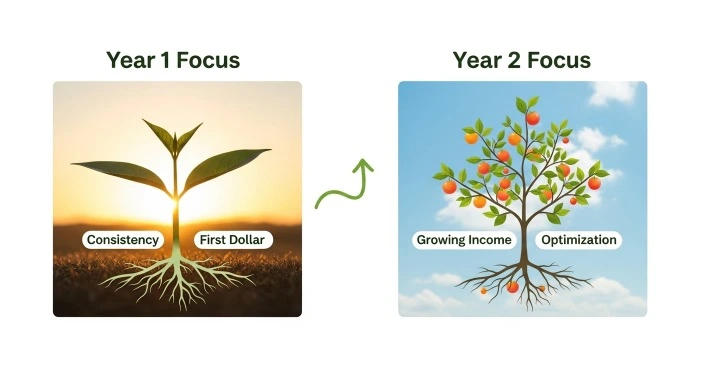
Year One Goals
Primary goal: Publish consistently and build your content library to 30-50 posts.
Secondary goal: Implement basic monetization and earn your first dollar, regardless of amount.
Stretch goal: Cover your annual blogging costs ($100-200) through blog income by month 10-12.
Notice that these goals focus heavily on the foundational work that enables future income rather than on earning specific amounts immediately. Hitting $500 monthly in year one would be exceptional, not typical. Hitting $50-100 monthly by the end of year one represents strong progress for a part-time blogger.
Year Two Goals
Primary goal: Reach $200-500 monthly income through growing traffic and optimized monetization.
Secondary goal: Identify your most effective monetization methods and double down on those.
Stretch goal: Achieve $1,000+ monthly income through some combination of traffic growth and higher-value monetization.
By year two, income becomes a more prominent focus because you’ve built the foundation that supports it. But even here, most part-time bloggers should aim for supplemental income levels ($200-1,000 monthly) rather than replacement income.
Frequently Asked Questions
Can I really make no money for a full year of blogging?
Yes, and this is more common than most blogging advice suggests. Many successful bloggers earned less than $100 total in their first 12 months. This doesn’t mean you’re doing something wrong—it means you’re building the foundation (traffic, content library, domain authority) that eventually supports meaningful income. The bloggers who quit after six months of zero income typically quit right before their traffic would have started growing significantly.
Which monetization method pays the fastest for new blogs?
Affiliate marketing typically generates income fastest because it doesn’t require minimum traffic thresholds and pays per action rather than per impression. Amazon Associates works even with very low traffic, though commissions are modest. Display ads through networks like AdSense can start immediately but pay very little until you reach thousands of monthly visitors. Neither method will generate substantial income quickly, but affiliate marketing usually produces your first earnings sooner.
Should I start multiple blogs to increase income chances?
No. Multiple blogs fragment your limited time and prevent any single blog from reaching the traffic levels that generate meaningful income. One blog with 10,000 monthly visitors earns far more than three blogs with 3,000 visitors each, despite equivalent total traffic, because higher traffic unlocks better monetization opportunities. Focus all effort on one blog until it reaches sustainable income levels before considering expanding.
How much does blog niche affect income timeline?
Significantly. Finance, business, and technology blogs often generate $500+ monthly with 5,000-10,000 visitors due to high-value advertising and affiliate programs. General lifestyle or entertainment blogs might need 20,000-30,000 visitors to reach equivalent income. This doesn’t mean avoiding lower-value niches if that’s your passion—just adjust income expectations accordingly. A hobby blog earning $200 monthly with 15,000 visitors is successful on its own terms.
What if I’m not making any money after 18 months of consistent blogging?
First, verify you’ve implemented basic monetization—affiliate links in relevant posts, an ad network if your traffic qualifies. If monetization exists but generates nothing, examine your traffic sources and volume. Are you getting at least 2,000-3,000 monthly visitors? If not, focus on SEO and content quality before worrying about monetization optimization. If traffic exists but monetization fails, your methods might not match your audience or niche. Consider consulting resources specific to your blog’s topic for targeted monetization strategies.
Final Thoughts: Moving Forward With Appropriate Expectations
Understanding when to expect your first blog income removes the mystery and frustration from the early stages of blogging.
You now know that earning little or nothing for your first 6-12 months is completely normal, not evidence of failure. You understand that reaching $200-500 monthly typically requires 12-24 months of consistent effort for part-time bloggers. You recognize that traffic volume, niche selection, and monetization strategy all influence your specific timeline.
Most importantly, you can stop measuring your progress against unrealistic expectations or outlier success stories. Your blog is developing on a typical timeline, even when that timeline feels frustratingly slow.
The work you’re doing now—publishing consistently, learning basic SEO, building your content library—creates the foundation that eventually supports blog income. Every post you publish, even the ones currently earning nothing, contributes to the traffic growth that makes future monetization possible.
Set realistic milestones: your first dollar earned, your first $10 month, your first $50 month. Celebrate these achievements appropriately rather than dismissing them because they’re not yet $1,000.
Blog income builds slowly, then compounds. The difference between month 18 and month 24 often exceeds all the growth that happened in the previous 18 months combined. Trust the process, maintain consistency, and let the timeline unfold at its natural pace.
Your first meaningful blog income is coming. It’s just coming on a longer timeline than the hype-driven blogging industry wants to admit. And that’s perfectly fine—because slow, sustainable income built on a solid foundation serves you better than quick money that disappears when you can’t maintain an unsustainable pace.
Read also : What Blogging Really involves
Our Authority Sources
This article draws on research and insights from established authorities in blogging, digital marketing, and online business development:
ProBlogger – Founded by Darren Rowse, one of the blogging industry’s most respected voices, ProBlogger conducts regular surveys of thousands of bloggers about their experiences, income levels, and timelines. Their research provides realistic benchmarks free from the selection bias of success-story-focused publications.
Ahrefs – Leading SEO tool and research company that studies search engine ranking patterns, content performance, and traffic growth timelines based on analysis of millions of websites. Their data-driven insights offer objective information about how long content typically takes to rank and generate traffic.
Income School – Educational resource focused on realistic blogging timelines and income expectations, particularly for part-time bloggers. They emphasize sustainable practices and honest income reporting rather than exceptional outlier cases.