
What blogging really involves
If you’re curious about starting a blog but feel confused by all the conflicting advice online, you’re not alone.
Most blogging guides assume you have endless free time, technical expertise, and a clear vision from day one. They throw around terms like “SEO,” “monetization strategies,” and “content calendars” without explaining what any of it actually means or why it matters.
This article cuts through the noise. We’ll walk through what blogging really involves — the actual tasks, the realistic time commitment, and the genuine skills you’ll need. No hype, no pressure, just a clear picture of what you’re signing up for.
By the end, you’ll understand whether blogging fits into your life right now, and if it does, what your first steps should look like.
The Core Components of Blogging: What You’ll Actually Be Doing
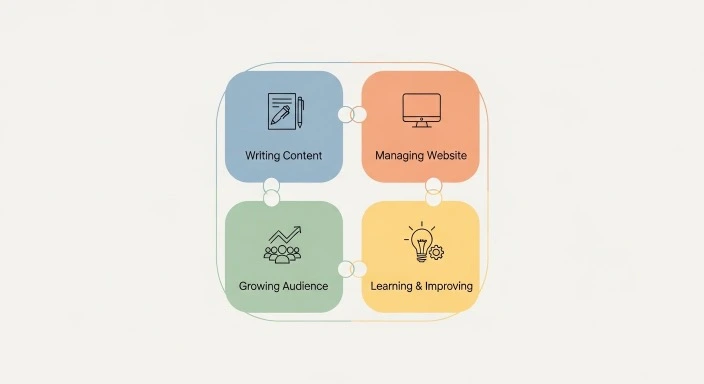
When you strip away all the jargon, blogging involves four main activities. Everything else is either a variation of these or something you can add later.
Writing and Publishing Content
This is the heart of blogging. You’ll be creating articles, guides, stories, or essays — whatever format matches your topic and style.
For most bloggers, one post takes anywhere from two to eight hours to complete. That includes research, writing, editing, finding or creating images, and formatting everything in your blog’s backend.
You don’t need to be a professional writer. You just need to communicate clearly and be willing to improve over time. Your first posts will likely feel awkward or incomplete. That’s completely normal. Writing is a skill that develops with practice, and blogging gives you a low-stakes way to build that skill.
The realistic frequency for busy beginners? One post per week is ambitious but doable. One post every two weeks is more sustainable for most people juggling other responsibilities.
Managing Your Website
Your blog lives on a website, which means you’ll need to handle some basic technical tasks.
This sounds scarier than it is. Most bloggers use platforms like WordPress, which handles the complicated coding behind the scenes. You’ll be working with a visual editor that’s similar to using Microsoft Word or Google Docs.
Your technical tasks will include:
- Choosing and customizing a theme (the visual design of your site)
- Installing plugins (small tools that add features like contact forms or social sharing buttons)
- Updating software when prompted
- Backing up your content periodically
- Troubleshooting occasional glitches
None of these require a computer science degree. They do require patience and a willingness to follow tutorials. When something breaks — and something will eventually break — you’ll likely spend an hour or two searching forums or watching YouTube videos to fix it.
According to research from Orbit Media Studios, most bloggers spend about 20% of their total blogging time on technical maintenance and updates. For someone publishing weekly, that’s roughly one hour per week on technical tasks.
Growing Your Audience
Publishing content doesn’t automatically bring readers. You’ll need to actively work on getting your blog in front of people.
The main ways bloggers build an audience are:
- Search engine optimization (SEO): Making your content easy for Google to find and recommend
- Social media sharing: Posting your articles on platforms where your potential readers already spend time
- Email newsletters: Building a list of subscribers who want your updates delivered directly
- Networking: Commenting on other blogs, joining communities, and building relationships in your niche
You don’t need to do all of these at once. In fact, trying to master every platform simultaneously is a fast track to burnout.
Most successful bloggers focus on one or two audience-building methods and get competent at those before expanding. If you enjoy Instagram, start there. If you prefer writing, focus on SEO and email. Play to your strengths rather than forcing yourself into strategies that drain you.
Learning and Improving
Blogging involves continuous learning. You’ll constantly be figuring out what works, what doesn’t, and how to get better.
This includes:
- Studying your analytics to see which posts attract readers
- Learning new writing techniques or content formats
- Staying current with platform changes (like Google algorithm updates)
- Developing new skills as your blog grows (photography, graphic design, video creation)
The learning curve feels steep at first, but it levels out. Your first three months will involve the most intense learning period. After that, you’ll have a foundation and will mostly be refining and optimizing.
The Real Time Commitment (Without the Sugarcoating)
Let’s talk numbers, because vague promises of “just 30 minutes a day” aren’t helpful.
Startup Phase (First 1-3 Months)
Expect to invest 10-15 hours during your first week just getting set up. This includes:
- Choosing a platform and hosting provider
- Setting up your domain name
- Installing and customizing your theme
- Creating essential pages (About, Contact, Privacy Policy)
- Writing your first 2-3 posts
After the initial setup, plan for 5-10 hours per week if you’re publishing once weekly. This breaks down roughly as:
- 3-6 hours writing and editing one post
- 1-2 hours on technical maintenance
- 1-2 hours on promotion or audience building
Established Routine (After 3-6 Months)
Once you’ve developed systems and templates, your time investment becomes more predictable. Many bloggers settle into a rhythm of 4-8 hours per week for one weekly post.
You get faster at writing. You know your website’s quirks. You’ve built templates for common tasks. The learning curve flattens.
The Flexibility Factor
Here’s what makes blogging manageable for busy people: almost nothing is time-sensitive.
Unlike a podcast interview or live video, you can write at 11 PM on a Tuesday or 6 AM on a Sunday. You can draft posts in 30-minute chunks over several days. You can schedule posts to publish automatically while you’re sleeping or on vacation.
This flexibility is blogging’s biggest advantage for people with unpredictable schedules.
What Skills You Actually Need (And What You Can Learn Along the Way)
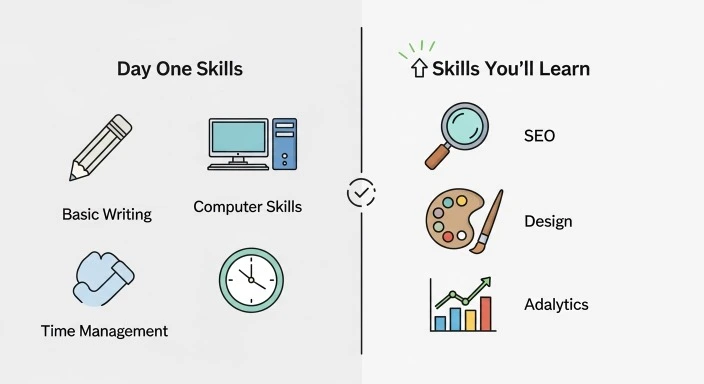
Skills You Need From Day One
Basic writing ability. You should be able to express your thoughts in complete sentences and organize information logically. You don’t need perfect grammar or a degree in journalism — just the ability to communicate clearly.
Basic computer skills. You should be comfortable navigating websites, downloading files, and following step-by-step instructions. If you can shop online and use email, you have enough technical knowledge to start.
Time management. You’ll need to carve out regular time for your blog and protect that time from other obligations. The most beautifully designed blog means nothing if you never actually write.
Skills You’ll Develop Over Time
SEO fundamentals. Understanding how search engines work and how to optimize your content for discovery. This seems mysterious at first but becomes intuitive with practice.
Basic design principles. Learning to create visually appealing layouts, choose readable fonts, and format content for easy scanning.
Headline writing. Crafting titles that accurately represent your content while also attracting clicks and reads.
Editing and self-critique. Spotting weaknesses in your own writing and improving drafts before publishing.
Analytics interpretation. Reading data about your traffic and using it to make informed decisions about future content.
None of these skills require innate talent. They’re all learnable through practice and patience. Every successful blogger started as a beginner who didn’t know what they were doing.
The Financial Reality: What Blogging Actually Costs
Minimum Startup Costs
You can start a blog for roughly $50-100 for your first year. This covers:
- Domain name: $10-15 per year
- Web hosting: $3-10 per month ($36-120 annually)
- Basic theme: $0-50 (many excellent free options exist)
That’s genuinely the minimum. Many bloggers operate successfully at this level for years.
Optional But Common Expenses
As your blog grows, you might invest in:
- Premium theme: $50-150 one-time purchase
- Email marketing service: $0-20 per month (most have free tiers for small lists)
- Stock photos or graphics: $0-30 per month
- Backup and security plugins: $0-100 per year
According to Webflow’s blogging cost analysis, the average blogger spends between $500-1,000 in their first year when including paid tools and services. But this is an average — plenty of successful blogs operate below this threshold.
Time vs. Money Tradeoff
Here’s an important principle: almost everything you can pay for, you can also do yourself for free by investing more time.
Paid themes save you design time. Stock photo subscriptions save you photography or graphic design time. Email service providers save you technical setup time.
When you’re starting out with more time than money, the free route makes sense. As your blog potentially generates income or as your available time decreases, paid solutions become more attractive.
Common Misconceptions That Trip Up Beginners
“I Need to Post Every Day to Succeed”
No, you don’t. Quality matters far more than quantity, and burnout helps no one.
One well-researched, helpful post per week will serve you better than seven rushed, mediocre posts. Search engines reward valuable content that answers real questions, not just high volume.
“I Need Thousands of Followers Before Anyone Will Read My Blog”
Your first readers will come from search engines, not social media followers. A single blog post that ranks well for a specific search query can bring you hundreds or thousands of visitors — regardless of how many Instagram followers you have.
Social media can amplify your reach, but it’s not the foundation of blogging success.
“Blogging Is Passive Income”
Blogging can eventually generate passive income, but there’s nothing passive about building a blog. You’ll work actively for months or years before seeing significant financial returns.
The “passive” part only applies once you’ve built a library of content that continues to attract readers and generate revenue without constant new effort. Getting to that point requires very active work.
“I Need to Be an Expert to Start”
You need to know slightly more than your target audience, or be willing to research topics thoroughly. You don’t need a PhD or ten years of industry experience.
Many successful blogs are written by people learning and documenting their journey. Your beginner perspective can actually be an advantage when writing for other beginners — you remember what it felt like to be confused.
The Hidden Challenges Nobody Warns You About
Motivation Fluctuation
Your enthusiasm will waver. Some weeks you’ll feel excited and energized. Other weeks you’ll question why you started this project at all.
This isn’t a sign you should quit — it’s a normal part of any creative endeavor. Having systems and schedules helps you push through the low-motivation phases.
The Comparison Trap
You’ll discover bloggers who seem to do everything better, faster, and more successfully than you. Their traffic numbers will be higher. Their design will be prettier. Their writing will feel more polished.
Remember: you’re seeing their highlight reel, not their blooper reel or their first year of struggle. Everyone successful was once exactly where you are now.
The Long Timeline to Results
Most blogs take 6-12 months before seeing meaningful traffic or engagement. Some take longer. This delayed gratification tests your patience and persistence.
Setting milestone-based goals helps more than traffic-based goals. Focus on publishing 10 posts, then 25, then 50. Celebrate what you can control (showing up, publishing consistently, improving your skills) rather than what you can’t (how quickly Google decides to rank your content).
Your First Steps: A Simple Action Plan
If you’re ready to start, here’s a realistic roadmap for your first month:
Week 1: Choose your platform and set up hosting. WordPress.org (self-hosted) is the most flexible option for serious bloggers. Spend time selecting a domain name you can live with for years.
Week 2: Install and customize a simple theme. Don’t obsess over perfection — you can always change designs later. Create your essential pages (About, Contact, Privacy Policy). Write your first blog post.
Week 3: Publish your first post. Write your second post. Start learning the basics of SEO by reading beginner guides from trusted sources like Moz or Yoast.
Week 4: Publish your second post. Begin researching topics for future posts. Set up Google Analytics and Google Search Console so you can eventually track your progress.
This pace feels manageable because it is. You’re building a foundation, not racing to a finish line.
Questions People ask
How long does it take to write a blog post?
For beginners, expect 4-6 hours per post including research, writing, editing, and formatting. As you develop your process and build expertise in your topic, this often decreases to 2-4 hours. Complex, research-heavy posts can take 8-10 hours regardless of experience level.
Do I need to show my face or use my real name?
No. Many successful blogs are written under pen names or run anonymously. However, building personal connection with readers does help with engagement and trust. Consider what level of privacy you need versus what level of personal brand-building serves your goals.
Can I start a blog while working full-time?
Absolutely. Most bloggers start as a side project while maintaining their day job. The key is setting realistic expectations about your publishing schedule and protecting your blogging time from other obligations. One post every week or two is completely achievable with a full-time job.
What if I’m not a good writer?
Writing is a skill that improves with practice. Your first posts will likely be rough, and that’s okay. Focus on clear communication rather than perfect prose. Over time, you’ll develop your voice and improve your technical skills. Every successful blogger has a cringeworthy first post buried in their archives.
How much money can I realistically make from blogging?
Most bloggers make nothing for their first year. Of those who persist, some eventually earn $100-500 per month, others build it into a full-time income of $3,000-10,000+ monthly. Income depends on your niche, monetization strategy, traffic levels, and business skills. Treat blogging as a long-term investment, not a quick money scheme. If you need income within 3-6 months, consider other side hustles while building your blog simultaneously.
What Success Actually Looks Like for Busy Bloggers
Success won’t look like the Instagram highlights of full-time bloggers who post daily and attend conferences around the world.
For busy people, success looks like:
- Publishing consistently (even if that’s just twice per month)
- Gradually building a library of helpful content
- Seeing slow but steady traffic growth over 12-24 months
- Connecting with a small but engaged community of readers
- Developing skills that serve you professionally and personally
- Creating something you’re proud of in whatever time you can spare
That’s not glamorous, but it’s real and achievable.
Next: Read The Ideal Blogging Platform for Beginners with Full Schedules
Our Authority Sources
This article draws on research and guidance from established authorities in blogging and digital marketing:
Orbit Media Studios – Annual blogger surveys providing data-driven insights into blogging practices, time investment, and success factors from thousands of bloggers worldwide. Their research is particularly valuable for understanding realistic timelines and effort requirements.
Moz – Industry-leading SEO education resource offering beginner-friendly guides on search engine optimization, an essential skill for bloggers seeking organic traffic growth.
Webflow – Web design and development platform that publishes thoroughly researched guides on blogging costs, technical requirements, and best practices for website management.