
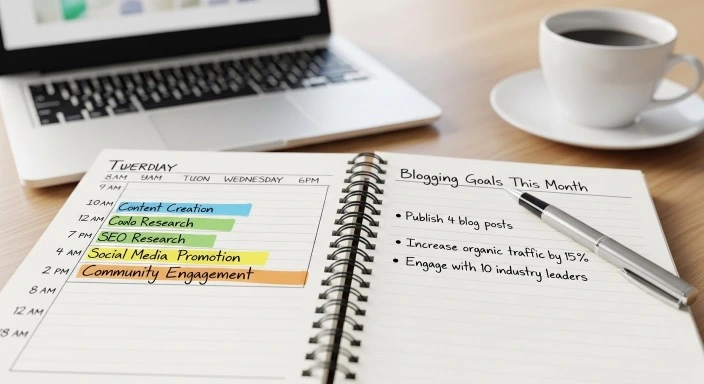
How to find time for blogging
Your calendar is packed. Between your job, family responsibilities, essential errands, and the basic maintenance of adult life, you’re already stretching your available hours thin. Yet here you are, wanting to start or maintain a blog despite having no obvious time to spare.
The standard advice—”wake up at 5 AM” or “just make it a priority”—feels insulting when you’re already operating at capacity. You don’t need motivation lectures or productivity hacks that assume you have endless flexibility in your schedule. You need honest, practical strategies for how to find time for blogging when your schedule is already full.
This isn’t about magically creating extra hours or sacrificing sleep you desperately need. It’s about realistic approaches that acknowledge your constraints while helping you carve out sustainable space for blogging without burning out or dropping other essential commitments.
If you’ve been telling yourself you’ll start blogging “when things calm down” or you’ve abandoned your blog because you couldn’t maintain the pace, this guide offers a different framework—one built for people whose lives won’t conveniently rearrange themselves around blogging ambitions.
Who This Guide Helps (And Who It Doesn’t)
This article is for you if:
- You want to blog but genuinely struggle to find time in an already-packed schedule
- You’re juggling work, family, or other major commitments that consume most of your day
- You need realistic strategies that don’t require overhauling your entire life
- You’ve tried to make time for blogging before and it hasn’t worked
This probably isn’t what you need if:
- You have significant blocks of free time but struggle with procrastination or motivation
- You’re looking for get-rich-quick blogging schemes
- You want someone to tell you blogging is easy if you just try harder
- You can dedicate 15+ hours weekly to blogging and need help optimizing that time
The Time Reality: How Much Do You Actually Need?
Before exploring how to find time for blogging, let’s establish realistic expectations about how much time blogging actually requires versus what you might assume.
The Minimum Viable Blogging Time
Research shows that it takes around 4 hours and 10 minutes on average to write a blog post. That’s an average—some posts take less, others significantly more depending on topic complexity, research requirements, and your writing speed.
For sustainable blogging when your schedule is full, you’re not trying to match professional bloggers publishing multiple times weekly. You’re looking for the minimum frequency that keeps your blog active and growing without demanding time you don’t have.
Here’s what that might actually look like:
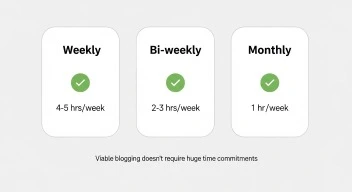
Weekly publishing: Requires approximately 4-5 hours per week (one post)
Bi-weekly publishing: Requires approximately 2-3 hours per week (one post every two weeks)
Monthly publishing: Requires approximately 1 hour per week (one post monthly, broken into smaller sessions)
Notice these are weekly time commitments, not daily. Finding one 4-hour block weekly is different from finding 30 minutes daily—both total similar hours, but fit different schedules differently.
The Hidden Time Costs
Beyond writing, blogging involves additional tasks that consume time:
- Topic research and idea development
- Image selection or creation
- Proofreading and editing
- Publishing and formatting
- Basic promotion (sharing on social media, newsletter)
These activities add approximately 30-90 minutes per post depending on how elaborate your process is. For busy bloggers, keeping these tasks minimal preserves scarce time.
What “Enough Time” Actually Means
You don’t need hours daily to maintain a viable blog. You need enough time to publish consistently at whatever frequency you can actually sustain.
Publishing one quality post monthly for a year builds more value than publishing daily for two months before burning out and quitting entirely. Consistency matters more than volume when time is limited.
If you’re wondering what blogging realistically involves for people with packed schedules, our foundational guide on what blogging involves when you have a full schedule breaks down the actual requirements versus common misconceptions.
Strategy 1: Audit Your Time Honestly (No Judgment)
You can’t find time for blogging without understanding where your time currently goes. This requires honest assessment without self-criticism.
Track One Week Exactly As It Is
For seven days, track how you actually spend your time—not how you think you spend it or how you wish you spent it, but reality.
Use a simple note app and jot down major time blocks:
- Work hours (including commute)
- Sleep
- Family time and responsibilities
- Meals and meal prep
- Exercise or health activities
- Essential errands and household tasks
- Entertainment and relaxation
- Phone scrolling and social media
The goal isn’t judgment about “wasted time.” It’s clarity about your actual patterns.
Identify Your True Discretionary Time
After tracking a week, look for genuinely discretionary time—periods where you could realistically make different choices without sacrificing sleep, work performance, family relationships, or basic self-care.
This might be smaller than you hoped. That’s okay. Working with honest numbers prevents the disappointment of planning based on time you don’t actually have.
Recognize the Difference Between Empty Time and Available Energy
You might have technically free time at 9 PM after kids are in bed, but if you’re exhausted and can barely think straight, that’s not realistic blogging time even though your calendar is empty.
Consider both time availability and energy levels. Some people write best early morning, others late evening. Some need complete mental freshness for writing, others can write when moderately tired.
Matching blogging time to your energy patterns makes the limited time you have more productive.
Strategy 2: Redefine What Counts as “Blogging Time”
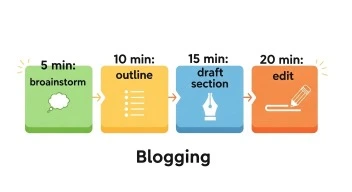
One reason busy people struggle to find time for blogging is defining it too narrowly—thinking you need uninterrupted hours at a desk to make progress.
Embrace Micro-Sessions for Different Tasks
Blogging isn’t one monolithic activity requiring long blocks. It’s multiple smaller tasks you can distribute across available moments:
5-10 minute sessions:
- Brainstorm post ideas
- Outline a post structure
- Research one specific fact
- Write a rough introduction
- Edit one section
- Find and save an image
- Write a social media caption
15-20 minute sessions:
- Write a complete rough draft of a short section
- Heavily edit a drafted post
- Format and schedule a completed post
- Research keywords for upcoming topics
30+ minute sessions:
- Draft a complete post
- Write and edit a shorter post from start to finish
- Record ideas and outlines for multiple future posts
Breaking blogging into micro-tasks lets you make progress during lunch breaks, while waiting for appointments, or in the evening when you have 15 minutes but not hours.
Count Thinking Time as Blogging Time
Some of your best blogging happens when you’re not actively writing—when you’re processing ideas during your commute, mentally outlining posts while walking, or thinking through how to explain something while doing dishes.
This mental work counts. When you sit down to write later, you’re not starting from zero because you’ve already developed the thinking.
Reframe “I don’t have time to write today” to “I’ll think about my next post topic during my drive”—this keeps you mentally engaged with blogging even when you can’t physically write.
Use Voice Notes for First Drafts
If you have hands-free moments—driving, walking, exercising—use voice recording to capture ideas or even dictate rough first drafts.
Talking through a post idea often flows faster than typing, and transcription services (many built into phones) can convert audio to text later. The draft will need editing, but you’ve created raw material during time that would otherwise produce nothing.
Strategy 3: Batch Similar Tasks for Efficiency
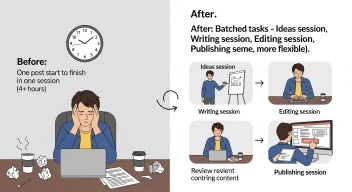
When time is scarce, efficiency becomes critical. Batching similar tasks reduces the mental overhead of constantly switching contexts.
Dedicate Sessions to Specific Activities
Rather than completing one post end-to-end in one session (ideation, drafting, editing, images, publishing), separate these into distinct batched activities:
Idea and outline session: Spend one hour brainstorming and outlining 4-5 future posts. Now you have a roadmap requiring no decision-making when you sit down to write.
Writing session: Focus purely on drafting with no editing. Get words on the page for one or multiple posts without perfectionism slowing you down.
Editing session: Return to completed drafts specifically to refine, fact-check, and polish. Your editing brain works differently than your drafting brain—separating these activities lets you work faster in each mode.
Publishing session: Format, add images, write meta descriptions, and schedule several completed posts in one sitting rather than doing this individually each time.
Create Reusable Systems and Templates
Build simple templates for recurring tasks so you’re not reinventing the wheel each time:
Post structure template: Create a standard outline structure for common post types (how-to guides, listicles, personal stories) that you can adapt rather than starting from blank pages.
Image workflow: Decide on one simple, repeatable approach to post images (maybe one specific free stock photo site, one editing tool, one standard size) so you’re not researching options every single post.
Publishing checklist: Write down your exact publishing steps so you can work through them quickly without mental energy spent remembering what comes next.
These systems eliminate decision fatigue and let you work faster within limited time.
Prepare Multiple Posts in Productive Periods
When you have a rare burst of available time or energy, use it to create a buffer rather than just publishing one post.
Draft two or three posts during a productive Saturday morning. You don’t need to publish them all immediately—schedule them out over coming weeks. This creates breathing room for periods when life gets chaotic and you can’t create anything new.
Strategy 4: Lower Your Standards (Temporarily or Permanently)
This might be the most important strategy, yet the hardest for many busy bloggers to accept: you cannot maintain the same quality and polish as bloggers who dedicate significantly more time to their work.
Good Enough Beats Perfect (or Nothing)
A solid 800-word post published this week provides more value than a perfect 2,000-word post you never finish because you don’t have time to make it “good enough.”
When time is limited, publishing consistently at good-enough quality builds more momentum than publishing rarely at exceptional quality.
Accept Shorter Posts
Not every post needs to be comprehensive, SEO-optimized long-form content. Shorter posts (500-800 words) addressing focused topics serve readers and take significantly less time to create.
You can always expand successful shorter posts later when you have more time. But starting with shorter posts keeps you publishing without the time investment longer pieces demand.
Skip Optional Bells and Whistles
When your schedule is packed, eliminate non-essential tasks:
Skip: Custom graphics for every post, extensive keyword research, elaborate social media campaigns, responding to every comment immediately, updating old posts frequently.
Keep: Solid writing addressing a clear topic, basic proofreading, simple images, one brief social share, occasional engagement.
The “skip” items are valuable when you have time. When you don’t, they’re optional—and choosing to skip them doesn’t make you a bad blogger.
Embrace Imperfection Publicly
Consider making peace with visible imperfection. A note at the top or bottom of posts acknowledging “This blog is written by a busy person in limited time—I prioritize consistency over polish” sets realistic expectations and removes pressure to meet unattainable standards.
Most readers appreciate honesty and relate to time constraints. Perfectionism serves you less than sustainable output.
For more perspective on managing blogging around limited time and energy, our article on how to resume blogging after a missed week addresses maintaining consistency despite inevitable interruptions.
Strategy 5: Protect Blogging Time Like an Appointment
Finding time for blogging when your schedule is full requires treating it as seriously as you treat work meetings or doctor appointments.
Schedule It Specifically
Vague intentions like “I’ll blog when I find time this week” don’t work when your schedule is packed. You need specific time blocks marked on your calendar.
“Tuesday 8-9 PM: Blog writing” or “Saturday 7-8 AM: Draft post” creates actual commitment rather than wishful thinking.
Communicate Boundaries to Others
If you live with family or roommates, they need to understand your blogging time is protected unless it’s an actual emergency.
A simple conversation: “I’m dedicating Tuesday evenings to writing. Unless something urgent happens, this is my time for this project.” Most people respect clear boundaries when you express them.
Say No to Competing Demands
When optional social invitations, additional projects, or non-urgent requests compete with your scheduled blogging time, practice saying no.
This doesn’t mean blogging trumps all other activities—it means your limited discretionary time deserves protection just like you’d protect other commitments.
Build in Flexibility for Life Disruptions
Protected time doesn’t mean rigid inflexibility. Schedule blogging time, but also have a backup plan: “If Tuesday doesn’t work this week, I’ll use Saturday morning instead.”
Life disrupts schedules. Successful busy bloggers plan for this by building flexibility into their systems rather than abandoning blogging entirely when one session gets derailed.
Strategy 6: Make Strategic Trade-Offs

Finding time for blogging when your schedule is full ultimately requires giving up something else. The question is what, and how to make those trade-offs consciously rather than defaulting to dropping blogging.
Identify Low-Value Time Uses
Look at your time audit honestly. Most people discover pockets of low-value activities that could shift to blogging without meaningful loss:
- 30 minutes of evening TV could become blogging time (while still protecting some relaxation time)
- Weekend social media scrolling could become Sunday morning writing sessions
- Podcast listening during commutes could occasionally shift to voice-note post drafting
The goal isn’t eliminating all leisure—it’s recognizing where you’re spending time on activities that don’t actually restore or fulfill you, and choosing to reallocate some of that time.
Consider What You Can Pause Temporarily
Maybe you can’t permanently eliminate other commitments, but could you pause some temporarily while establishing your blogging routine?
Could you take a season off from a volunteer role? Pause a hobby you enjoy but could return to later? Skip attending every optional social event for a few months?
These temporary pauses create breathing room to build blogging habits that eventually require less conscious effort.
Accept That Something Must Give
Here’s the uncomfortable truth: you cannot add a meaningful new commitment (blogging) to an already-full schedule without subtracting something else.
Trying to squeeze blogging into an unchanged schedule sets you up for the overwhelm and failure that leads to quitting. Making conscious trade-offs creates sustainable space.
Evaluate Trade-Offs Against Your Values
When deciding what to give up or reduce, align choices with your actual values and goals.
If blogging serves important purposes (building your business, processing your thoughts, creating something meaningful), it might justify reducing time on activities that don’t align as strongly with what matters most to you.
This isn’t about judging activities as “good” or “bad”—it’s about conscious alignment between time use and priorities.
Strategy 7: Use Constraints as Creative Advantages
Limited time doesn’t just create challenges—it can improve your blogging by forcing focus and efficiency.
Tight Time Limits Force Clear Thinking
When you only have 30 minutes to write, you can’t meander or over-explain. You get to the point quickly and write more directly than you might with unlimited time.
This constraint often produces tighter, more readable writing than the verbose posts that emerge from excessive time.
Small Time Blocks Prevent Procrastination
It’s easier to procrastinate when you’ve allocated three hours for a task. Thirty minutes creates urgency that bypasses perfectionism and second-guessing.
Set a timer for your available time block and write until it rings. You’ll often produce more usable content in focused sprints than in long, distracted sessions.
Limited Capacity Clarifies Priorities
When you can only publish monthly, you can’t write about every fleeting idea. This forces you to identify which topics matter most, resulting in more focused, valuable content.
Constraints drive strategic thinking busy bloggers with unlimited time might skip.
Necessity Breeds Simple Systems
Bloggers with ample time can build elaborate workflows. Busy bloggers must create streamlined systems or nothing gets published.
This simplicity often serves you better long-term—fewer moving parts mean fewer things to break when life gets chaotic.
What Doesn’t Work (And What to Avoid)
Certain strategies sound good but reliably fail for busy people trying to find time for blogging.
Don’t Rely on “Finding” Motivation
Waiting until you feel motivated to blog means you’ll rarely blog. Busy schedules drain energy and motivation naturally.
Successful busy bloggers don’t rely on motivation—they rely on systems, scheduled time, and commitment to showing up whether they feel like it or not.
Don’t Copy Strategies from Full-Time Bloggers
Advice from people blogging full-time or with significant available time doesn’t translate to packed schedules.
“Write daily” or “publish three times weekly” works for people with 20+ hours weekly for blogging. It fails when you have five hours monthly. Ignore strategies built for different circumstances.
Don’t Add Blogging Without Removing Something Else
Trying to layer blogging onto an unchanged full schedule creates the overwhelm that leads to burnout and quitting.
You must consciously subtract other activities to create space. Pretending you can “make it work” without trade-offs sets you up for failure.
Don’t Expect Immediate Results
If you’re finding limited time to blog, progress will be slower than if you could dedicate substantial hours weekly.
Accept this. Publishing monthly means slower growth than publishing weekly. That’s fine—monthly publishing for years builds more than weekly publishing for three months before quitting.
Don’t Let Perfect Blogging Time Prevent Good Enough Blogging Time
“I’ll start blogging when I have more time” or “I’ll wait until I can dedicate proper time to this” are common mental traps.
Your schedule likely won’t magically open up. Start with whatever time you have now, even if it feels inadequate. Imperfect action beats perfect planning.
Frequently Asked Questions
What if I literally have zero free time in my current schedule?
If honest time tracking shows absolutely no discretionary time and you’re already sacrificing sleep or health to meet basic obligations, you probably shouldn’t add blogging right now. That’s not failure—it’s realistic assessment. Consider whether your situation is temporary (new baby, major work deadline, health crisis) where you might return to blogging later, or whether fundamental schedule changes are needed before blogging is viable. Sometimes the answer is “not right now,” and that’s okay.
How do I blog consistently when my schedule varies unpredictably week to week?
Build flexibility into your system rather than rigid routines. Instead of “every Tuesday at 8 PM,” commit to “one writing session per week, scheduled Sunday based on that week’s calendar.” Keep a running list of next possible time slots (morning before work, lunch break, evening after dinner) and grab whichever becomes available. Create a buffer of drafted posts during calmer periods to publish during chaotic ones. The key is consistent output (weekly or monthly posts) even if the timing of creation varies.
Should I wake up earlier or stay up later to make time for blogging?
Only if you’re genuinely getting adequate sleep otherwise and can shift your schedule without sacrificing health. Sleep deprivation tanks your energy, focus, and writing quality—making blogging harder, not easier. If you’re already barely sleeping enough, stealing sleep for blogging will backfire through exhaustion and burnout. If you’re sleeping 8+ hours and could reasonably shift bedtime slightly, early morning or late evening sessions work well for some people. But never sacrifice necessary sleep.
What if I start making time for blogging and then fail to maintain it?
This is normal and expected, not a sign you should quit. Most busy bloggers have periods of consistency followed by gaps, then rebuild their routine. If this happens, use it as information: was your time commitment unrealistic? Did you attempt perfectionism that made blogging too hard? Did life circumstances change temporarily? Adjust your approach based on what you learn, and start again with a more sustainable plan. Missing time doesn’t mean failure unless you let it stop you permanently.
How long before I can expect to see results if I’m only blogging monthly or bi-weekly due to time constraints?
Progress will be slower than if you published more frequently, but you’ll still see results if you persist. Expect 6-12 months before you notice meaningful traffic growth or audience development with monthly publishing. This timeline extends if you’re in a competitive niche or just learning SEO and promotion. The advantage: sustainable pace means you’re more likely to still be blogging in a year when results start appearing, versus burning out from an unsustainable schedule in month three.
The Final Thoughts
Learning how to find time for blogging when your schedule is already full isn’t about discovering a magical time-creation technique or developing superhuman discipline. It’s about honest assessment of your actual available time, strategic choices about how to use it, and accepting that blogging with limited time looks different from blogging with abundant time—but can still be valuable and sustainable.
You don’t need to wake at 4 AM, eliminate all leisure, or somehow squeeze 15 hours weekly from a schedule that’s already maxed out. You need to find your realistic minimum viable blogging time—maybe it’s one hour weekly for a monthly post, maybe it’s three focused 20-minute sessions for bi-weekly posts—and protect that time like you protect other commitments.
The bloggers who succeed with packed schedules aren’t more disciplined or more passionate than you. They’ve simply accepted that their blogging journey will unfold more slowly, their posts might be shorter and simpler, and their growth will be gradual—and they’ve made peace with that reality instead of quitting when they couldn’t match idealized versions of “successful blogging.”
Your constraints aren’t obstacles to overcome before you can “really” blog. They’re the actual conditions under which you blog, and working skillfully within them is what sustainable blogging looks like for busy people.
The question isn’t whether you have enough time to be a “proper” blogger. It’s whether you can carve out enough consistent time—even small amounts—to publish regularly at a frequency you can actually maintain. If the answer is yes, you have enough time. Everything else is just finding the specific strategies that work within your unique constraints.
Start where you are, with the time you actually have, creating the simplest sustainable system you can manage. That’s not the compromise version of blogging—it’s realistic blogging for people with full lives beyond their blogs. And it’s exactly enough to build something meaningful over time.
Our Authority Sources
Orbit Media Studios – Blogger Time Investment Survey – Annual research tracking how long bloggers actually spend creating content, revealing the 4+ hour average per post that informs realistic time planning for busy bloggers.
Harvard Business Review – Time Management Research – Evidence-based research on time auditing, scheduling strategies, and making sustainable behavior changes in packed schedules, providing foundation for the practical strategies outlined.
Cal Newport – Deep Work and Time Blocking (Georgetown Computer Science professor and productivity researcher) – Research on focused work sessions, batching similar tasks, and protecting scheduled time, particularly relevant for busy bloggers working in limited time blocks.
Laura Vanderkam – 168 Hours: Time Management Research – Time-use researcher whose work on honest time tracking and identifying discretionary hours informs the audit-based approach to finding blogging time.