
How to resume blogging after a missed week
You missed a week of blogging. Maybe life got hectic, work demanded extra hours, someone got sick, or you simply ran out of steam. Now you’re staring at your blog dashboard, feeling that familiar mix of guilt and uncertainty about how to start again.
The gap feels bigger than it actually is. Seven days without publishing shouldn’t derail your entire blogging journey, yet here you are, wondering if your readers noticed, whether your momentum is gone, and how to pick up where you left off without it feeling awkward or forced.
Here’s what most blogging advice won’t tell you: missing a week is completely normal, your blog didn’t die while you were gone, and resuming doesn’t require a dramatic comeback announcement or perfect execution. You just need a simple, realistic plan to get back into rhythm without the pressure or overwhelm that probably contributed to the break in the first place.
This guide shows you exactly how to resume blogging after a missed week—what to publish first, how to rebuild your writing routine, and most importantly, how to prevent guilt and perfectionism from turning a short break into a permanent one.
Who This Article Helps (And Who It Doesn’t)
This guide is for you if:
- You missed publishing for a week and feel stuck about restarting
- You’re a beginner or side hustler blogging around other commitments
- You want practical steps to resume without perfectionism blocking you
- You need reassurance that missing time doesn’t mean failure
This might not help if:
- You’ve been gone for months (not weeks) and need a complete relaunch strategy
- You’re looking for motivation rather than practical resumption tactics
- You haven’t actually started blogging yet and are planning ahead
- Your blog operates on strict professional deadlines requiring different approaches
Understanding What Actually Happened During Your Week Off
Before rushing to fix anything, let’s establish reality versus the story your anxious brain is telling you.
Your Blog Didn’t Die
Unless you were publishing daily to a news site, one week of silence didn’t destroy your blog. Your existing content still exists, still gets discovered through search, and still provides value to new readers finding you for the first time.
Most blogs—especially those run by busy people—don’t publish daily or even multiple times weekly. Your readers expect occasional gaps because they’re busy too. They understand life happens.
You Probably Didn’t Lose Readers
Email subscribers didn’t mass-unsubscribe because you missed a week. Search traffic to your existing posts continued. Social media followers didn’t forget you existed.
The perceived urgency around “losing momentum” assumes your readers sit waiting for your next post like it’s a weekly TV show. In reality, most readers discover your content through search weeks or months after publication, not the day you hit publish.
The Guilt Is Normal But Unhelpful
Feeling bad about missing time is a natural response when you care about your blog. It means this matters to you. But guilt doesn’t improve your next post or help you resume effectively—it just makes restarting harder.
The goal isn’t eliminating guilty feelings (that’s unrealistic). It’s recognizing them and choosing to act anyway, knowing that resuming imperfectly beats waiting until you “feel ready,” which may never arrive.
Momentum Isn’t As Fragile As It Feels
Writing momentum—the ease and flow you experience when blogging regularly—does fade when you stop. But it rebuilds faster than you think. Your second post back won’t be as hard as your first, and by your third, you’ll likely feel most of the rhythm returning.
Think of momentum like physical fitness. Missing a week at the gym doesn’t erase all progress. You might feel slightly rusty initially, but muscle memory kicks in quickly. Blogging works the same way.
What to Publish First When You Resume
The question “what should I write about?” often keeps people frozen longer than the actual break. Here’s how to choose your comeback post without overthinking it.
Resist the Urge to Explain Your Absence
You don’t owe readers a “Sorry I’ve been gone” post unless you’ve been absent for months. A week doesn’t require explanation or apology.
These meta posts about your blogging process feel necessary when you’re anxious about the gap, but they serve your need for absolution more than your readers’ need for value. Your audience came for helpful content about your topic, not updates about your publishing schedule.
Just post useful content like nothing happened. Your consistency moving forward matters far more than acknowledging the gap.
Choose Something Easier Than Usual
Your first post back doesn’t need to be your best work ever or make up for lost time with extra length or complexity.
Pick a topic you could write about comfortably even while tired or distracted:
- A listicle pulling together existing knowledge you already have
- A tutorial walking through something you do regularly
- A review of a tool you’ve used extensively
- An update or expansion of an existing post
The goal is building momentum through completion, not creating your masterpiece. Save ambitious projects for when you’re back in rhythm.
Use What You Already Started
If you have drafts sitting partially finished, consider completing one rather than starting fresh. Even if the draft isn’t perfect, finishing something generates forward motion and removes the intimidation of a blank page.
Quick polish on an 80% complete draft and hitting publish accomplishes more psychologically than starting a new post from scratch and potentially stalling again.
Look at What’s Already Working
Check your analytics for posts getting consistent traffic. Can you write a follow-up, a deeper dive into one aspect, or an updated version with fresh information?
Building on proven content reduces decision paralysis and increases the likelihood your comeback post performs well, giving you positive reinforcement to keep going.
Rebuilding Your Writing Routine Without Pressure

Getting back into regular blogging requires reestablishing habits without setting yourself up for another crash.
Start Smaller Than Before
If you were trying to publish twice weekly before the gap, don’t resume at that pace immediately. Start with once weekly or even every ten days.
Your brain needs to rebuild the habit pathway first. Consistency at a sustainable frequency beats ambitious scheduling that leads to another burnout and break.
You can always increase frequency later once the routine feels solid again. But if you overpromise to yourself and miss deadlines immediately after resuming, you reinforce the cycle of guilt and avoidance.
Pick One Specific Day and Time
Habit formation research consistently shows that attaching new behaviors to specific times strengthens the likelihood they stick.
Instead of “I’ll blog when I have time this week,” commit to “Every Wednesday at 8 PM, I sit down to write.” The specificity removes daily decision-making and creates a clear boundary you can protect.
Even if Wednesday at 8 PM only gives you 30-45 minutes initially, showing up consistently matters more than the duration. You’re rebuilding the pattern.
If you’re working blogging into a packed schedule and need strategies for writing in limited time blocks, our guide on how to write a blog post when you only have 30 minutes breaks down exactly how to make short sessions productive.
Separate Writing from Publishing
One reason bloggers burn out is treating every writing session as “must finish and publish today.” This creates massive pressure that makes sitting down to write feel overwhelming.
Instead, separate these activities:
- Writing sessions: Draft, outline, develop ideas with no publication deadline
- Editing sessions: Refine, fact-check, add links to drafted content
- Publishing sessions: Format, add images, schedule posts from edited drafts
This separation means you can make progress even when you don’t have enough time for complete end-to-end post creation. Fifteen minutes drafting still moves you forward, removing the all-or-nothing thinking that leads to avoidance.
Lower Your Publication Standards Temporarily
Your first few posts back don’t need perfect SEO, comprehensive coverage, or flawless prose. They need to exist.
Good-enough posts that go live beat perfect posts that stay in draft purgatory. Once you rebuild momentum and confidence, you can raise your standards again. Right now, shipping content matters more than perfection.
This doesn’t mean publishing garbage—it means accepting that a solid, helpful post with minor imperfections serves readers better than no post at all while you wait for inspiration or perfect conditions.
Handling the Mental Obstacles to Resuming
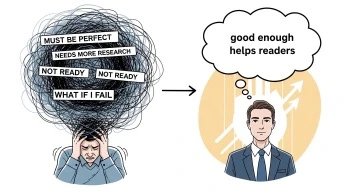
The practical steps above only work if you address the psychological barriers keeping you stuck.
Perfectionism Disguised as Standards
Notice if you’re telling yourself you can’t publish yet because your next post needs to be amazing, comprehensive, or significantly better than your previous work.
This is perfectionism masquerading as quality control. It creates impossible standards that ensure you’ll never feel ready, giving you a convenient excuse to avoid the discomfort of getting back in the arena.
Real standards mean “this provides clear value and doesn’t contain major errors.” Everything beyond that is perfectionism protecting you from judgment, which ironically keeps you from the progress that builds genuine skill.
All-or-Nothing Thinking About Frequency
“If I can’t publish twice weekly like I planned, there’s no point publishing at all.”
This black-and-white thinking ignores the reality that publishing something beats publishing nothing, regardless of frequency. A blog with twelve decent posts published monthly over a year builds more value and audience than a blog with zero posts because the creator abandoned it after missing their ambitious twice-weekly schedule.
You don’t need permission to adjust your publishing frequency. The only person holding you to your original plan is you, and you can change it right now.
Comparison to Others
Scrolling through other blogs in your niche and seeing their consistent publishing schedules while you’ve been absent triggers comparison that makes resuming harder.
Remember: you don’t know their circumstances. Maybe they batch-write content, maybe they have help, maybe they’re publishing lower-quality posts quickly, or maybe they’re also struggling but you’re only seeing their public success.
Your blogging journey isn’t a competition with theirs. Your only benchmark is whether you’re better than yesterday’s version of yourself, and resuming after a break means you are.
Fear That You’ve “Lost It”
Worried that the ease and flow you felt before the gap is gone permanently? That your writing ability disappeared during the week off?
This fear is common but inaccurate. Writing skill doesn’t evaporate from short breaks. What you’re actually feeling is rustiness—the temporary awkwardness of reactivating a skill you haven’t used recently.
The only way through rustiness is writing anyway. Your second paragraph will feel smoother than your first. Your second post will feel easier than your first. Trust the process instead of interpreting temporary discomfort as permanent loss of ability.
What to Avoid When Getting Back to Blogging
Certain approaches feel productive but actually make resuming harder or set you up for another break.
Don’t Make Grand Announcements or Promises
Publicly declaring “I’m back and committing to daily posts!” creates pressure and sets expectations you may not meet, especially if you’re still figuring out a sustainable rhythm.
These announcements are often attempts to use public accountability to force yourself into consistency, but they backfire when life inevitably gets busy again and you face the shame of breaking your promise.
Just quietly resume with good content. Let your consistency speak for itself over weeks and months rather than promising it upfront.
Don’t Try to Make Up for Lost Time
You can’t publish three posts in one week to compensate for the week you missed. Well, you could, but you’d likely exhaust yourself and miss the following week too, perpetuating the cycle.
Your blog isn’t graded on total posts per month with penalties for gaps. Some months will have more posts, some fewer. That’s normal and fine. Accept the gap as past and focus on sustainable forward progress rather than impossible catch-up.
Don’t Batch-Write Everything at Once
The instinct to spend an entire weekend writing multiple posts to “get ahead” is understandable but often counterproductive for busy bloggers.
Marathon writing sessions work for some people, but for many, they lead to burnout that causes another break. Additionally, the pressure to write multiple posts in one sitting often results in either lower quality or not finishing any of them.
Sustainable blogging for busy people usually looks like shorter, regular sessions rather than occasional marathons.
Don’t Ignore Why You Stopped
If you missed the week because you were simply busy with unplanned obligations, that’s one thing. But if you stopped because blogging started feeling like a burden, you dread writing, or you’re not clear on why you’re doing this, resuming without addressing those underlying issues sets you up for another break soon.
Take honest inventory:
- Are you trying to blog at an unsustainable frequency?
- Are you writing about topics that actually interest you or topics you think you “should” cover?
- Do you have realistic expectations about blogging’s timeline and results?
- Is your motivation clear, or are you blogging out of obligation?
Fixing these foundational issues now prevents the cycle of starting, stopping, guilt, and restarting repeatedly.
Don’t Apologize Excessively
In your first post back or to your email list, resist the urge to over-explain or repeatedly apologize for the gap.
Brief acknowledgment is fine: “Been a busy couple weeks, but I’m back with…” But dwelling on the absence or being overly apologetic signals that you think you did something wrong, which you didn’t.
Life happened. You took a break. Now you’re back. That’s the whole story, and it doesn’t require justification or extended apology.
Practical Steps: Your First 48 Hours Back
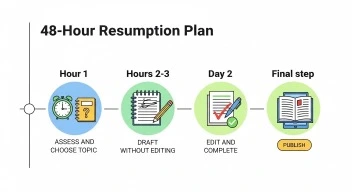
Here’s a concrete action plan for resuming that removes decision fatigue and gets you moving quickly.
Hour 1: Assess and Choose
Spend 30-45 minutes reviewing:
- Partially completed drafts—can you finish one quickly?
- Analytics for top-performing posts—could you write a follow-up?
- Simple post ideas you’ve captured in notes or ideas files
- Questions readers have asked via comments or email
Pick one topic that feels manageable right now. Not the most important topic or the most ambitious—the one you could write about even if you’re tired or distracted.
Hour 2-3: Draft Without Editing
Sit down and write the first draft of your chosen topic. Don’t edit as you go, don’t research extensively, don’t worry about perfection.
Get 500-800 words down in rough form. It doesn’t need to be complete—you just need enough material that you can see this is going somewhere.
If you get stuck, write in bullet points or conversation style like you’re explaining the topic to a friend. You can clean it up later.
Next Day: Edit and Complete
Come back to your draft with fresh eyes. Read through, fill in gaps, add any necessary research or examples, check for clarity.
This isn’t about achieving perfection—it’s about taking the rough draft to “good enough to publish” status. Fix obvious errors, ensure your main points are clear, add a simple introduction and conclusion.
Aim to have a complete, publishable post within 1-2 hours of editing work.
Final Steps: Publish Without Ceremony
Add any necessary images (even simple stock photos work), check formatting, write a straightforward meta description, and hit publish.
Don’t wait for the “right time” or optimal publishing day. Don’t spend hours on Pinterest graphics or perfect SEO optimization. Those things can happen with future posts once you’re back in rhythm.
Right now, getting this first post live matters more than it being optimized. Published beats perfect.
If email list sending feels daunting, you can skip it for this first post. Or send a simple email: “New post: [Title]. [One sentence description]. [Link].” Save elaborate email strategy for when you’re comfortable again.
Building Safeguards Against Future Breaks
Once you’ve resumed, put systems in place to prevent the guilt-break-guilt cycle from recurring.
Create a Content Buffer
When you’re in a good blogging rhythm, write one or two extra posts beyond what you need immediately. Keep these as a buffer for weeks when life gets chaotic.
Having backup posts ready removes the pressure during busy periods. You can publish from your buffer instead of skipping entirely, maintaining visible consistency even when you can’t actively create new content that week.
This buffer doesn’t need to be elaborate—even one extra post ready to go makes a difference during unexpected busy periods.
Plan for Predictable Busy Periods
If you know certain times of year are reliably hectic (tax season if you’re self-employed, back-to-school if you have kids, Q4 if you work retail), adjust your blogging expectations for those periods in advance.
Rather than trying to maintain your normal schedule and failing, plan reduced frequency during those windows. Publish biweekly instead of weekly, or pause entirely with a planned resume date.
Intentional adjustments don’t carry the same guilt as reactive breaks, and they prevent burnout from trying to maintain impossible standards during genuinely busy seasons.
Separate Your Worth from Your Publishing Frequency
Your value as a blogger—and as a person—isn’t determined by how many weeks in a row you published without missing.
When you internalize this, missing a week becomes a practical scheduling gap rather than evidence of failure or inadequacy. This shift in perspective makes resuming easier because you’re not carrying shame and self-judgment alongside the practical task of writing a post.
You’re allowed to be a blogger who sometimes takes breaks. That’s sustainable long-term blogging, not failing at blogging.
Revisit Your “Why” Regularly
Every few months, reconnect with why you started blogging and what you hope to achieve.
When your motivation is clear and compelling to you personally—not because someone said you “should” blog—the inevitable ups and downs of the journey feel more manageable. Missing a week doesn’t mean giving up on something important; it means taking a brief pause in ongoing work that matters to you.
If you can’t articulate why you’re blogging beyond vague ideas about “building an audience” or “making passive income,” that lack of clarity makes every obstacle feel like a reason to quit. Strong, personal motivation carries you through rough patches.
For more context on building sustainable blogging practices that prevent burnout, our article on what blogging actually involves when you have a full schedule addresses realistic expectations for busy bloggers.
Frequently Asked Questions
Should I explain to readers why I missed a week of publishing?
No, not for a week-long gap. Most readers won’t have noticed, and those who did likely assumed you were busy with life—which is accurate and needs no elaborate explanation. Save explanations for extended absences (a month or more). For a week, just resume posting useful content without meta-commentary about the gap.
What if I lost motivation during the break and don’t feel excited about blogging anymore?
Motivation follows action more than it precedes it. Don’t wait to feel motivated before resuming—that feeling may never arrive. Commit to publishing one post despite not feeling excited, and notice whether completing it and seeing it live regenerates any motivation. If after 2-3 posts you still feel nothing, that’s when to seriously evaluate whether blogging aligns with your current goals, not after just one week off.
How do I prevent missing another week right after getting back?
Start with a more conservative publishing schedule than you maintained before the break. If you were posting twice weekly, resume with once weekly. This isn’t giving up—it’s right-sizing your commitment to what you can actually sustain given your current life circumstances. You can always increase frequency later, but another immediate break after resuming damages confidence more than starting with modest, achievable consistency.
My blog is for my business—will missing a week hurt my SEO or search rankings?
One week without new content has essentially zero impact on SEO for established blogs. Google doesn’t penalize sites for not publishing constantly. Your existing content continues performing in search, and rankings depend far more on content quality, backlinks, and relevance than publication frequency. Focus on resuming with good content rather than worrying about imaginary SEO penalties from brief gaps.
What if I missed the week because I ran out of ideas—how do I resume when I still don’t know what to write about?
Start with lower-effort content formats while ideas rebuild: update an existing post with new information, compile a roundup of your best tips from previous posts, answer a reader question via email in post form, or review a tool you use regularly. These require less creative inspiration than original topic development but still provide value and get you publishing. Ideas tend to flow more easily once you’re actively writing again rather than staring at a blank idea list.
The Final Thoughts
Missing a week of blogging doesn’t require a dramatic comeback, an elaborate explanation, or weeks of preparation before you’re “ready” to resume. It requires one simple choice: writing and publishing your next post despite any discomfort, guilt, or uncertainty you’re feeling about the gap.
The mechanics of resuming are straightforward—pick a manageable topic, draft without perfection pressure, publish without ceremony. The real challenge is mental: overcoming the voice insisting you need to apologize, catch up, or prove yourself before you’ve earned the right to simply continue.
You don’t need to earn your way back to blogging. You don’t need permission to adjust your frequency or lower your standards temporarily. You don’t need to explain yourself to readers who likely didn’t notice your absence or wouldn’t judge you if they did.
What you need is to close this tab, open your blog’s dashboard, and write something. Not your best post ever. Not a perfect post. Just the next post, imperfect and complete, ready to go live and remind you that you’re still a blogger who creates useful content when life allows it.
The gap between your last post and your next post only grows bigger if you keep waiting for the perfect moment to resume. That moment is right now, exactly as you are, even if you don’t feel entirely ready. Start anyway.
Blogging isn’t about never missing time—it’s about resuming when you do. You’ve already done the hard part by reading this far and considering how to move forward. Now prove to yourself that breaks don’t end your blogging journey unless you let them by choosing not to come back.
Write your next post. Hit publish. Everything else figures itself out from there.
Our Authority Sources
This article draws on research and guidance from established authorities in blogging, content creation, and sustainable creative work:
ProBlogger (Darren Rowse) – One of blogging’s longest-running authorities, ProBlogger has addressed consistency challenges and realistic blogging practices for over 15 years, providing perspective grounded in supporting thousands of bloggers through the full lifecycle of building and maintaining blogs.
Copyblogger – Content marketing publication offering research-based guidance on sustainable content creation practices, particularly addressing the balance between consistency and quality for creators managing blogs alongside other commitments.
Atomic Habits (James Clear) – While not blogging-specific, Clear’s research on habit formation and rebuilding routines after disruption provides scientific foundation for the behavioral strategies recommended in this guide, particularly regarding the importance of starting small after breaks.
Content Marketing Institute – Industry research organization tracking content creator challenges, including data on publishing frequency, burnout patterns, and sustainable practices for solo and small-team content creation.
These sources were selected for their long-term track records supporting sustainable creative work rather than promoting unsustainable hustle culture, and for grounding advice in real blogger experiences rather than theoretical ideals.