
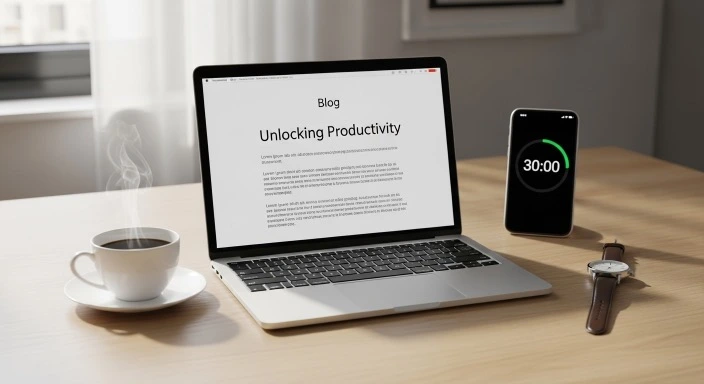
Write a blog post in 30 minutes
Thirty minutes. That’s all the time you have before your next meeting, before the kids get home, before you need to start dinner, or before whatever else fills your day demands your attention.
Most blogging advice assumes you have leisurely two-hour blocks to craft the perfect post. Research thoroughly, write eloquently, edit meticulously, optimize completely. It all sounds wonderful—and completely unrealistic for someone with a packed schedule.
But here’s what most guides won’t tell you: you can write a genuinely useful blog post in 30 minutes. Not a finished, polished, ready-to-publish masterpiece. But a solid draft that moves your blog forward and gets you one step closer to hitting publish.
The key isn’t writing faster or cutting corners on quality. It’s understanding what you can realistically accomplish in a short session and having a system that makes those 30 minutes count.
This guide shows you exactly how to write a blog post when you only have 30 minutes. You’ll learn what preparation makes short writing sessions possible, what to focus on during those 30 minutes, and how to turn scattered fragments into complete posts over time.
Who This Guide Is For (And Who It’s Not For)
This guide is for you if:
- Your available blogging time comes in 30-minute pockets, not multi-hour blocks
- You want to maintain publishing consistency despite a chaotic schedule
- You’re willing to write posts across multiple sessions rather than all at once
- You need concrete strategies for maximizing limited writing time
This might not be for you if:
- You regularly have 2+ hour blocks available for writing
- You prefer to complete entire posts in single sessions
- You’re looking for shortcuts that compromise content quality
- You’re comfortable with your current writing process and just want to speed it up
Understanding What “Writing a Post in 30 Minutes” Actually Means
Before we dive into the method, let’s clarify what’s realistic and what’s not.
What You CAN Do in 30 Minutes
You can draft 400-600 words of rough but usable content. This represents one major section of a blog post, not an entire article.
You can outline a complete post structure with all your main points identified and ordered logically.
You can edit and refine one section of an already-drafted post, catching errors and improving clarity.
You can research and gather the source material you’ll need for a specific post topic.
What You CAN’T Do in 30 Minutes
You can’t write, edit, format, optimize, and publish a complete 1,500-2,000 word blog post from scratch. Anyone claiming otherwise is either writing very short content, producing rushed work, or has years of practice you don’t have yet.
You can’t conduct thorough research AND write comprehensive content in the same 30-minute session.
You can’t create a polished, ready-to-publish post if you’re still learning your topic or developing your writing voice.
The realistic approach: Write complete blog posts across multiple 30-minute sessions. Three to five short sessions produce better results than trying to cram everything into one rushed marathon.
If you’re wondering how this fits into broader time management strategies, our guide on blogging efficiently when you have minimal free time covers the bigger picture of working in fragments.
The Pre-Work That Makes 30-Minute Writing Sessions Possible
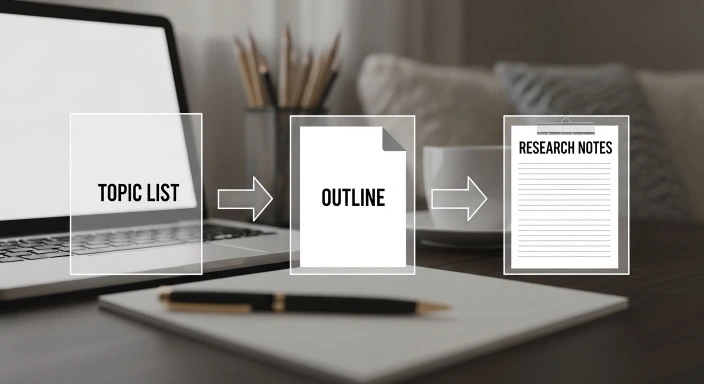
Successful 30-minute writing sessions don’t start when you sit down to write. They start with preparation that happens separately.
Keep a Running List of Post Ideas
When inspiration strikes—in the shower, during your commute, while reading something else—capture it immediately in a simple note-taking app or document.
Your list doesn’t need elaborate descriptions. Just enough to remember the core idea:
- “How to stay motivated when your blog isn’t growing”
- “Mistakes I made choosing my blog niche”
- “Why I switched from Bluehost to SiteGround”
Having 10-20 topic ideas ready eliminates the “what should I write about?” question that wastes precious minutes at the start of each session.
Create Post Outlines in Advance
During found moments—waiting for an appointment, riding public transportation, commercial breaks—open your post idea list and flesh out one topic into a rough outline.
A basic outline includes:
- Working title
- 3-5 main section headers (H2s)
- 2-3 sub-points under each header
- Any examples or data points you want to include
This takes 5-10 minutes and prepares the framework for your actual writing session. When you sit down for your 30 minutes, you’re filling in a structure rather than creating from scratch.
Batch Your Research Separately
Research and writing require different mental modes. Trying to do both in the same 30-minute session fragments your focus and reduces output.
Instead, dedicate separate short sessions to research:
- Spend 15-20 minutes gathering sources, statistics, quotes, or examples for a specific post
- Save everything in a simple document or note with your outline
- Include source links so you can properly cite them later
When you sit down to write, your research is already compiled and accessible. You’re just incorporating it into your draft rather than stopping to search for information mid-paragraph.
According to research from the Content Marketing Institute, bloggers who separate research from writing typically complete posts 30-40% faster overall because each phase benefits from focused attention.
The 30-Minute Writing Session: Step-by-Step
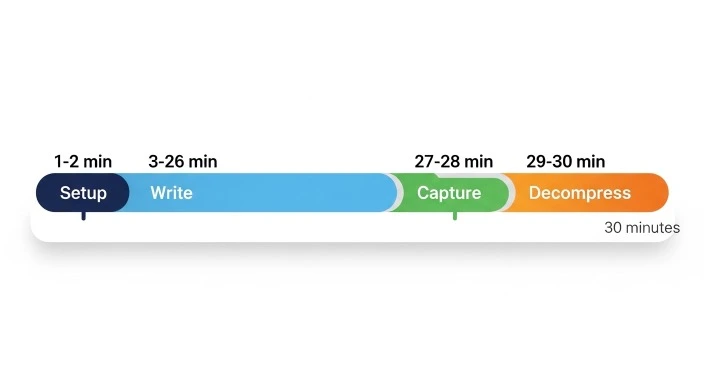
You’ve got your outline ready, your research compiled, and exactly 30 minutes before your next obligation. Here’s how to use that time effectively.
Minutes 1-2: Set Up and Review (Don’t Skip This)
Open your outline and research document. Reread them quickly to refresh your memory about what you’re writing.
Set a timer for 28 minutes (you need the final 2 minutes for wrapping up).
Close email, social media, messaging apps, and anything else that might interrupt you. Notifications destroy focus during short sessions where every minute counts.
Decide which section you’re tackling. If this is your first session on this post, start with the introduction or the first main section. If you’ve already written some parts, continue where you left off.
Minutes 3-26: Write Without Stopping
Your single goal: get words on the page following your outline. Everything else is secondary.
Write continuously: Don’t stop to look up the perfect word, check a fact, or rewrite a sentence. Keep your fingers moving. Awkward phrasing, uncertain claims, and incomplete thoughts are fine. You’re drafting, not polishing.
Use placeholders: If you can’t remember a statistic, write [INSERT STAT]. If you need an example, write [EXAMPLE HERE]. If you’re unsure about phrasing, write it badly and add [FIX THIS] in brackets. Keep moving forward.
Follow your outline: Your headers are your roadmap. Write a few paragraphs for the current section, then move to the next header. Don’t get stuck trying to perfect one section.
Ignore your inner editor: That voice saying “this sounds terrible” or “you need to explain this better”? Acknowledge it and keep writing anyway. Editing happens later. Right now, you’re creating raw material to edit.
Track your progress: Glance at your timer occasionally. If you’re 15 minutes in, you should have 200-300 words drafted. If you’re behind, don’t stress—just keep writing.
The average person types 40-50 words per minute when they know what to say. With some pauses for thinking, you can realistically draft 400-600 words in 24 minutes if you’re not stopping to edit or research.
Minutes 27-28: Quick Capture
Stop writing even if you’re mid-sentence. Use these final minutes to:
Save your work: Obviously essential but easily forgotten in the rush.
Note where you stopped: Add a quick sentence about what comes next: “Continue with section on common mistakes” or “Need to add conclusion next.” This helps you resume quickly in your next session.
Capture fleeting thoughts: If ideas for the next section occurred to you while writing, jot them down quickly before they vanish.
Mark problem areas: If you noticed sections that need work, add a quick note: [Section about timing feels weak—revisit].
Minutes 29-30: Decompress
Close your document. Take three deep breaths. Acknowledge what you accomplished rather than fixating on what’s unfinished.
You just drafted 400-600 words. Over three 30-minute sessions, that’s a complete 1,200-1,800 word post. This is real progress, even though it doesn’t feel as satisfying as completing an entire post in one sitting.
Structuring Your Post Across Multiple Sessions
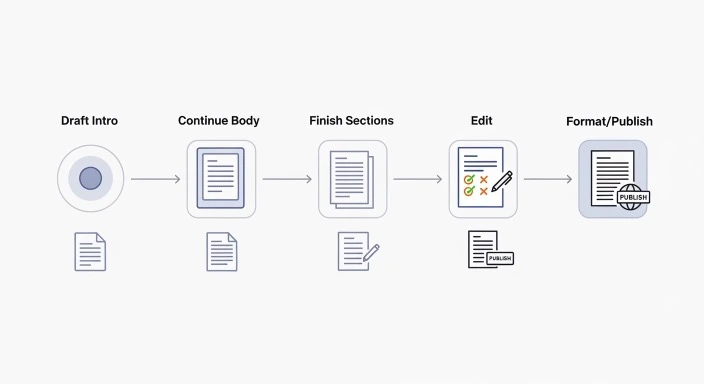
Most blog posts require 3-5 thirty-minute sessions to complete. Here’s a realistic breakdown.
Session 1: Introduction and First Section
Write your introduction (100-200 words establishing the topic and promising value).
Draft your first major section following your outline (300-500 words).
This session produces your post’s foundation. You’ve established tone and begun delivering on your promise.
Session 2: Middle Sections
Continue drafting the main body sections according to your outline.
Aim to complete 2-3 sections depending on their complexity and length.
By the end of this session, you have 60-70% of your post’s content drafted.
Session 3: Conclusion and Remaining Sections
Finish any incomplete sections from session 2.
Write your conclusion (150-250 words summarizing key points and providing next steps).
Add any examples, quotes, or supporting details you skipped in earlier sessions.
Your post now has complete content from introduction to conclusion.
Session 4: Editing and Polishing
Read through your entire draft, fixing awkward phrasing and unclear explanations.
Fill in any placeholders ([INSERT STAT], [EXAMPLE HERE]).
Check that sections flow logically and connect smoothly.
This session transforms your rough draft into readable content.
Session 5: Formatting and Optimization
Add or improve header tags (H2s, H3s) for better structure.
Insert or verify links (internal and external).
Write or refine your meta description.
Add images and alt text.
Do a final proofread for typos and errors.
This final session makes your post ready to publish.
Total time investment: 2.5 hours spread across a week or two, working in manageable chunks that fit your schedule. Compare this to trying to block out a single 3-4 hour session you never quite find.
Writing Techniques That Maximize Your 30 Minutes
Use the “Voice First” Method
Instead of typing, speak your ideas into your phone’s voice recorder while doing routine tasks—commuting, folding laundry, washing dishes.
Later, during a 30-minute session, listen and transcribe the key points. Your spoken thoughts often sound more natural and conversational than text written from scratch.
This won’t work for every post or every writer, but for those who think better out loud, it can double your effective writing time.
Embrace “Shitty First Drafts”
Author Anne Lamott popularized this concept in her book on writing: give yourself permission to write badly in first drafts.
Your goal in these 30-minute sessions isn’t producing beautiful prose. It’s getting ideas out of your head and into a document where you can work with them.
Bad writing can be edited into good writing. No writing can’t be edited at all. Choose bad writing over no writing every time.
Work from Templates
Create a basic template for common post types you write:
How-to post template:
- Introduction (problem + promise)
- Prerequisites or context
- Step-by-step process
- Common mistakes
- Conclusion with next steps
Listicle template:
- Introduction
- Item 1 (description + example)
- Item 2 (description + example)
- Continue for all items
- Conclusion
Opinion/commentary template:
- Introduction (state your position)
- Background/context
- Main argument + supporting points
- Counter-arguments addressed
- Conclusion restating position
Templates provide structure so you’re not reinventing organization every time. You just fill in content following the proven pattern.
Use Strategic Repetition
Don’t reinvent explanations for concepts you address frequently.
If you regularly mention “why consistency matters in blogging,” write one great explanation and reuse it (with minor variations) across multiple posts.
This isn’t lazy—it’s efficient. Readers encountering each post individually won’t notice the repetition, and you save time not rewriting the same explanations differently each time.
What to Avoid When Writing in Short Sessions
Don’t Try to Write Perfectly
Perfectionism is the enemy of productivity in short sessions. You don’t have time to craft the perfect opening sentence or find the ideal phrasing.
Write adequately in your first draft. Polish in later editing sessions. Separate creating from refining.
Don’t Switch Tasks Mid-Session
If you’re drafting new content, don’t suddenly switch to editing what you wrote last session. If you’re editing, don’t start writing new sections.
Task-switching wastes time as your brain shifts gears. Commit to one type of work per session.
Don’t Research and Write Simultaneously
“Let me just look up that statistic real quick…”
Twenty minutes later, you’re deep in a research rabbit hole with nothing written.
If you realize you need information mid-draft, write [RESEARCH: conversion rate statistics] and keep writing. Look it up in a future session designated for filling in gaps.
Don’t Expect Linear Progress
Some 30-minute sessions will produce 600 words of great content. Others will yield 300 words of mediocre material you’ll mostly rewrite later.
This variability is normal. Your energy, focus, and familiarity with the topic fluctuate. Some days the words flow, others they don’t. Keep showing up anyway.
Don’t Skip the Outline
“I’ll just start writing and see where it goes…”
This works sometimes for experienced writers on familiar topics. For most people on most posts, it leads to rambling content that requires extensive restructuring.
Your outline takes 5-10 minutes but saves you 20-30 minutes of wandering around your topic without direction.
Frequently Asked Questions
Can I really publish quality content written in 30-minute sessions?
Yes, with two caveats. First, you need multiple sessions per post—typically 3-5 for a complete article. Second, “quality” means helpful and clear, not necessarily as polished as content written in longer, focused sessions. Most readers care more about usefulness than perfect prose. Your 30-minute-session posts will be good enough to provide value, build audience, and serve your blogging goals, even if they’re not literary masterpieces.
What if I can’t finish a thought before my 30 minutes runs out?
Stop mid-sentence if necessary and add a note about where you were heading: [was going to explain the three-step process]. This actually makes resuming easier next session because you already know your starting point. Trying to reach a “good stopping point” often means rushing or running over your time limit, which defeats the purpose of structured short sessions.
How do I maintain consistency in tone across sessions days apart?
Read the last 2-3 paragraphs you wrote before starting each new session. This reminds you of your voice and flow. Also, embrace minor inconsistencies in first drafts—your editing session will smooth out tonal variations. As long as your overall piece sounds like you and serves your reader, perfect tonal consistency isn’t necessary.
Should I write posts in order from introduction to conclusion?
Not necessarily. Write whichever section you feel most prepared to tackle. Some writers prefer starting with the easiest section to build momentum. Others begin with the most important section while they’re freshest. The introduction often comes last—it’s easier to introduce a post once you know exactly what it contains. Use your outline to keep track of what’s written and what remains.
What if 30 minutes isn’t enough even for one section?
Some sections genuinely require more time because they’re complex or you’re still developing your ideas about them. That’s fine. Either extend that session by 10-15 minutes if possible, or accept that this particular section will take two sessions. Not every section fits neatly into 30 minutes. The system provides structure, not rigid rules.
Tools That Support Short Writing Sessions
Simple Note-Taking Apps
You don’t need sophisticated writing software. Google Docs, Notion, Apple Notes, or even simple text files work perfectly for capturing outlines and drafts.
The key features you need:
- Accessible from anywhere (cloud-based or synced)
- Quick to open (no waiting for slow software to launch)
- Auto-save (so you don’t lose work if time runs out)
Fancy writing apps with elaborate features often distract rather than help during short sessions.
Timers
Your phone’s built-in timer works, but dedicated focus timers can help:
Pomodoro apps structure 25-minute work sessions with 5-minute breaks. Close to your 30-minute target and widely available.
Focus@Will and Brain.fm provide background music designed to improve concentration during time-limited work sessions.
The timer keeps you honest about when to stop and prevents sessions from bleeding into other commitments.
Distraction Blockers
Freedom, Cold Turkey, or your phone’s built-in “Do Not Disturb” mode block distracting websites and apps during your writing sessions.
When you only have 30 minutes, a single distraction can destroy 20% of your productive time. Blocking temptation prevents self-sabotage.
Voice Recording Apps
Your phone’s voice recorder or apps like Otter.ai (which transcribes automatically) let you capture thoughts when typing isn’t convenient.
This extends your effective writing time beyond formal sessions by capturing ideas that occur during in-between moments.
Making Peace with the Fragmented Process
Writing blog posts across multiple short sessions feels different from the traditional “sit down and write a complete post” approach.
It’s less satisfying initially because you never experience the rush of completing something start-to-finish. Progress feels incremental rather than dramatic.
But this approach has significant advantages for busy bloggers:
You actually do it. Five 30-minute sessions scattered across two weeks happens. One 3-hour block you perpetually postpone doesn’t.
Quality often improves. Time between sessions lets ideas marinate. You return with fresh perspective that catches problems you’d miss writing straight through.
Sustainability increases. Short sessions don’t exhaust you or require sacrificing other priorities. You can maintain this approach indefinitely without burnout.
The key is measuring success differently. Instead of “Did I finish a post today?” ask “Did I move a post forward today?” Progress counts even when completion remains future.
For more context on building sustainable blogging habits with limited time, see our guide on what blogging really involves when you’re working around a full schedule.
The Final Thoughts
Learning how to write a blog post when you only have 30 minutes isn’t about writing faster or accepting lower standards. It’s about restructuring your writing process to work with the time you actually have rather than the time you wish you had.
The fragmented approach—outlines prepared separately, research batched independently, drafting spread across sessions—feels awkward initially if you’re accustomed to completing posts in single sittings. But this system accommodates real life’s interruptions and limitations while still producing quality content.
Your posts won’t materialize as quickly as they would with dedicated multi-hour blocks. A post might take a week or two to complete rather than an afternoon. That’s the trade-off. But slow, steady publishing beats no publishing, and consistent progress beats abandoned drafts.
The 30-minute session framework gives you a realistic way forward when traditional advice about “just finding more time” rings hollow. You’re working with the time you have, making every available minute count, and building your blog through accumulated effort rather than sporadic marathons.
Start with one post. Apply this process across four or five short sessions. Notice how completable it feels compared to blocking out hours you don’t have. Then do it again with your next post.
Over time, you’ll refine your personal version of this system—learning which preparatory steps help most, which sections you write fastest, which times of day your 30 minutes are most productive. The structure provides the foundation. Your experience builds the efficiency.
You have 30 minutes. That’s enough to make real progress on a real post that will eventually reach real readers. Stop waiting for longer blocks that never arrive and start writing in the time you actually have.